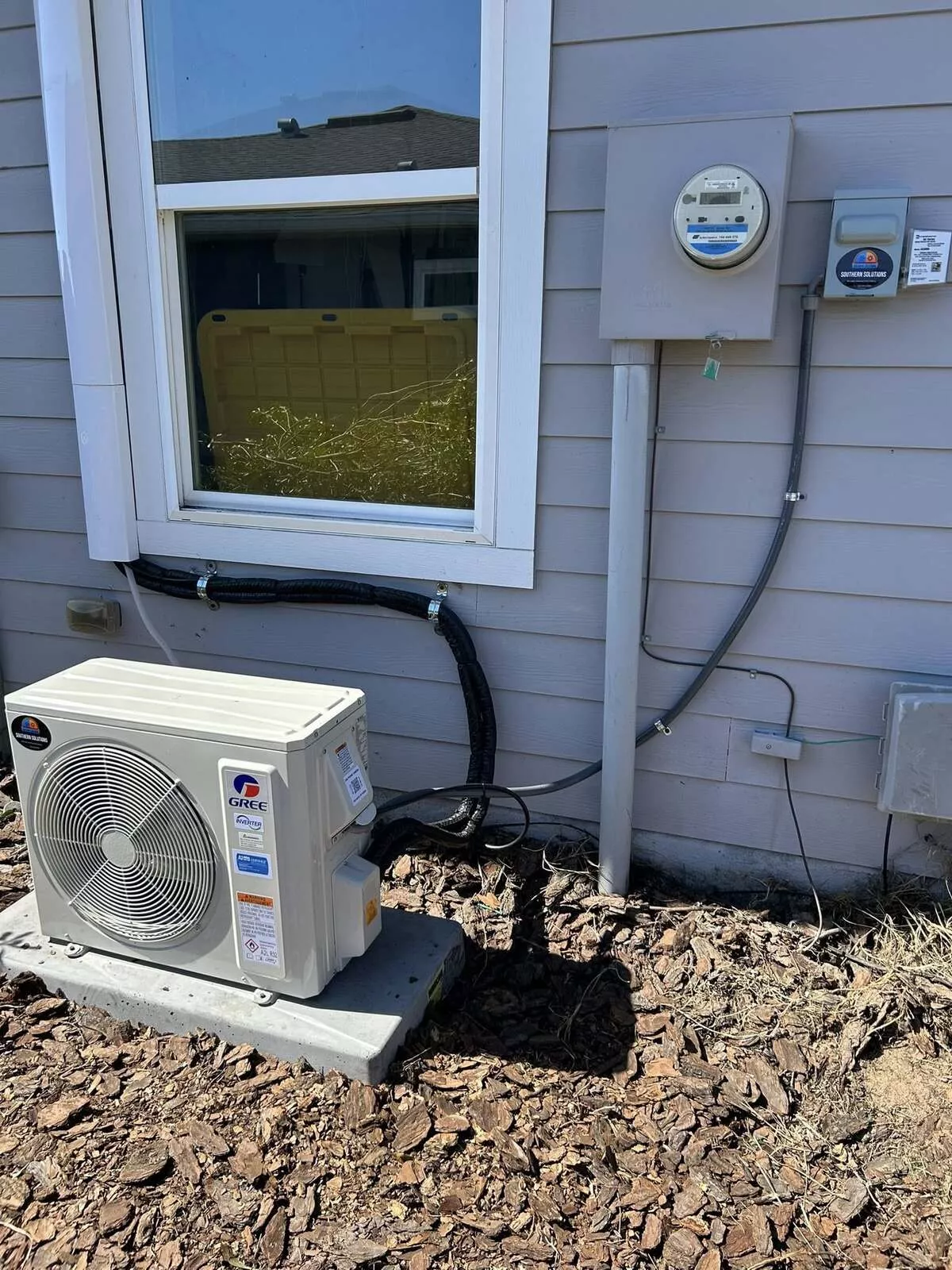
A heat pump running constantly on a cold morning can be working correctly, not failing. Output falls as outdoor temperature falls, so the same machine takes longer to deliver the same heat. What is not normal is a house that cannot reach temperature in moderate cold, or backup heat running in mild weather.
The distinction that resolves most of this
The distinction below is the one to keep in mind when judging a heat pump in cold weather.
A heat pump rated to operate at a given temperature is not rated to deliver its full capacity at that temperature.
Those are different claims, and marketing routinely blurs them. “Works down to −5 °F” means the machine still runs and still produces useful heat at −5 °F. It does not mean it produces as much heat at −5 °F as it does at 45 °F. Capacity falls steadily as the outdoor air gets colder, because the outdoor air is where the heat is being taken from and there is less of it available.
Xcel Energy, which supplies both electricity and natural gas in Boulder, defines a cold-climate air source heat pump as one that operates efficiently down to −5 °F. That is a genuine and useful threshold. It is a statement about operation, not about output.
Here is why a homeowner cannot easily check this for themselves. The Northeast Energy Efficiency Partnerships, which maintains the cold-climate heat pump specification and product list used by efficiency programs across the country, notes that the standard performance metric has a specific blind spot: HSPF “does not include low temperature testing points below 17°F, assumes the use of electric resistance elements, and tests in steady-state operation.” NEEP adds that supplemental cold-weather performance information from manufacturers “is not standardized or consistent.”
So the number on the box is measured in conditions warmer than a Boulder January night, and assumes resistance backup is doing part of the work. That is not a scandal — it is a rating standard doing what rating standards do — but it means the gap between “what it says” and “what you experience at 8 °F” is real, structural, and not your imagination.
What a heat pump is actually doing when it gets cold
Why output falls as the temperature falls
A heat pump does not create heat. It moves heat that already exists in the outdoor air into your house, using a refrigerant circuit running in reverse of a fridge. That is why it can deliver more heat energy than the electrical energy it consumes, and why it is cheaper to run than electric resistance heating.
It is also why cold weather reduces its output. There is less heat available in 20 °F air than in 45 °F air, and the machine has to work harder to extract it. Both the capacity and the efficiency fall together. Nothing is broken; the physics is simply less generous.
Why running constantly can be correct
A modern heat pump, particularly a variable-speed one, is designed to run long and slow rather than short and hard. Long run times at low output hold temperature more evenly and more efficiently than repeated full-power bursts.
This genuinely confuses people coming from a gas furnace, which either roars or is silent. A heat pump that runs for hours on a cold day is behaving as designed. Run time is not the symptom. Failing to hold the setpoint is the symptom.
Defrost, and why your heat pump is steaming
On a cold, damp morning the outdoor coil can drop below freezing while pulling heat from the air, and moisture in that air frosts onto it. Frost insulates the coil and degrades performance, so periodically the system runs a defrost cycle: it temporarily reverses, warming the outdoor coil to melt the ice.
During defrost the outdoor unit may steam dramatically, the outdoor fan may stop, and indoors you may briefly get cool air — which is why backup heat can be set to engage during defrost, deliberately, to stop the house feeling the dip.
Defrost is normal. What is not normal is ice that never clears, ice building into a solid block, or defrost running constantly.
What is normal in a Boulder winter
Boulder’s normal January low is 21.5 °F, with a normal high of 47.0 °F and a monthly mean of 34.3 °F, according to NOAA’s 1991–2020 climate normals for the Boulder station. December and February sit within about a degree of January at the low end.
Set that against Xcel’s −5 °F cold-climate definition and the picture is reassuring: an ordinary Boulder winter night sits well inside the operating range of a cold-climate heat pump. The nights that genuinely challenge one are the outliers, not the norm.
So on a typical Boulder winter day, normal looks like: long run times, particularly overnight and in the early morning; supply air that feels cooler than a gas furnace’s because it is delivered at a lower temperature over a longer period; occasional defrost cycles with visible steam; and backup heat engaging during defrost and on the coldest nights.
What is not normal
The house cannot hold temperature in moderate cold
If the setpoint is 68 °F and the house is sitting at 60 °F when it is 25 °F outside, that is not the physics being unkind. Something is wrong — undersizing, a fault, or an installation problem.
Backup heat running in mild weather
Backup heat engaging at 10 °F is expected. Backup heat engaging at 45 °F is not. The checks are whether an outdoor lockout was configured, whether the thermostat brings backup on whenever the setpoint is raised, and whether the heat pump itself is impaired and the backup is quietly carrying the house.
That last case is the expensive one, because from the living room a working heat pump and a failed heat pump with functioning backup feel similar — until the bill arrives. What the backup is and what it costs is covered in why auxiliary heat sends the bill up, and the setting that governs when it engages in the outdoor lockout sensor your heat pump probably does not have.
Ice that does not clear
Light frost between defrost cycles is normal. A coil encased in ice, ice building up underneath the unit, or a unit that never completes a defrost is not. Persistent ice points at a defrost control fault, a refrigerant problem, or drainage — an outdoor unit sitting where meltwater refreezes around it will keep re-icing.
The bill
A heat pump should cost less to run than resistance heating. If your winter bill has jumped several-fold rather than risen with the weather, the likely explanation is that resistance backup is carrying load the heat pump should be carrying.
Why you cannot tell mis-sold from mis-installed from the living room
This is the genuine difficulty, and pretending otherwise does not help anyone.
A homeowner posting on a trade forum in February described replacing an oil boiler with a two-zone heat pump system in a roughly 2,900 sq ft house. On very cold days, below about 25 °F, the system could not keep up: both zones set to 68, upstairs reaching the high 50s, downstairs the mid 50s, remote rooms the high 40s. Insulation had been upgraded at the same time. The system was specified to work far below that temperature.
What they wrote next is the heart of it. They laid out exactly two hypotheses — either there is an outstanding installation or configuration problem, or the system is installed correctly and simply cannot keep up on days when it defrosts a lot — and said they could not choose between them. They also said their installers were not experts in the equipment they had fitted, that there had been oversights during the install, and that they no longer trusted the installer’s judgement about what to try next.
That is not an unusual situation and it is not a stupid homeowner. It is a person correctly identifying that two very different problems produce the same experience, with no way from inside the house to distinguish them.
The distinguishing evidence is measurement, and it exists. A correctly specified system has a documented balance point — the outdoor temperature below which the heat pump alone can no longer meet the house’s heat loss — derived from a load calculation and the equipment’s own capacity data at low temperature. If the house is failing to hold temperature above its design balance point, that is a fault or a configuration error. If it is failing below it, the backup is supposed to be covering the gap, and the question becomes whether the backup is sized and configured correctly.
Without that number, everyone is guessing. With it, the argument resolves.
There is a second sizing trap worth knowing about, because it produces this exact complaint in a system where nothing has failed. A heat pump serves two loads — cooling in summer and heating in winter — and in a climate like Boulder’s those two loads are not the same size. Size the equipment around the cooling load and it can be comfortably adequate in July while running out of capacity on a January night. Size it around the heating load and it can be oversized for cooling, short-cycling in summer and dehumidifying poorly.
Which load a system was sized around is a decision somebody made at installation, and it is rarely explained to the buyer. It is a fair question to ask, and the answer should be a load calculation for both, not a rule of thumb about square footage.
The Boulder-specific part
Two local facts matter, and they pull in different directions.
A quarter of this county heats with electricity. The American Community Survey’s 2019–2023 five-year estimates report electricity as the primary heating fuel in 24.3% of Boulder County occupied housing units, rising to 33.6% within Boulder city. That table cannot distinguish a modern heat pump from electric resistance baseboard, so it is not a heat pump adoption rate.
And the professional advice you get here is contradictory. A Colorado homeowner in climate zone 5 — the same zone as Boulder County — posting on a trade forum about moving off gas reported that some contractors told him heat pumps do not work in Colorado, while others were happy to take his money, and he had no basis for choosing between them. The replies pointed him at the actual question: where the balance point falls at his utility rates, and equipment rated to operate down to 5 °F without backup.
That exchange is the local situation in miniature. “Do heat pumps work in Boulder” is the wrong question, because it has no answerable form. The answerable question is at what outdoor temperature your gas rate beats your electric rate for your house — a calculation specific to the building and the tariff, which neither contractor in that story offered.
Boulder has good local coverage of the policy side of heat pumps — whether the city should electrify, what the incentives are, how adoption is going. What has been much harder to find is the operational answer: it is 8 °F, my heat pump has been running for six hours, is that normal. That is what this page is for.
Where this stops, and why
Everything above is observation, and observation is yours. The refrigerant circuit is not, and the reason is specific rather than a general caution.
A heat pump’s performance in cold weather is determined largely by refrigerant charge, and charge cannot be judged by feel, by how cold the line looks, or by whether the unit seems to be running. It is determined by measuring pressures and temperatures and comparing them against the manufacturer’s charging chart for that model at that outdoor condition. A system that is undercharged looks, from outside, exactly like a system that is simply working hard in the cold — which is the whole problem this page exists to address.
Refrigerant circuits are also sealed pressurised systems containing regulated substances, and the outdoor unit carries mains voltage and a capacitor that holds a charge after power is removed. Opening either is not a homeowner task.
What is yours: keeping the outdoor unit clear of snow, ice and debris, keeping filters clean, noting the outdoor temperature when problems occur, and noting whether the backup heat indicator is showing.
One thing overrides all of it. If a carbon monoxide alarm sounds — relevant in a dual-fuel house where a gas furnace is the backup — get everyone out of the building and call emergency services before doing anything else.
What a correct diagnosis looks like
For a heat pump underperforming in cold weather, a correct diagnosis produces numbers, not reassurance.
It should establish the balance point for your house and equipment — the outdoor temperature below which the heat pump alone cannot meet the load — from a load calculation and the manufacturer’s capacity data at low temperature, not from a rule of thumb. Nearly every argument about whether a heat pump is “big enough” is really an argument about a number nobody has calculated.
It should establish when backup heat is configured to engage, and whether an outdoor lockout exists. That is a commissioning setting somebody chose.
It should include measured refrigerant performance against the manufacturer’s chart for the outdoor conditions on the day, rather than a verdict on how the system feels.
It should confirm defrost operation — that cycles initiate, complete and terminate properly — rather than inferring it from the presence of ice.
And it should distinguish clearly between “this system is faulty” and “this system is working as specified but was specified for a different house.” Those need completely different remedies, and conflating them is how homeowners end up paying for a repair that changes nothing.
If a contractor tells you heat pumps do not work in Colorado, that is not a diagnosis either. Ask them at what outdoor temperature they calculate your gas becomes cheaper than your electricity, and how they arrived at it. How that question is answered tells you a great deal about who you are dealing with — a subject covered in the full guide to winter heating in Boulder.
What rebates still apply to a heat pump in 2026 is in our rebates guide, and when one is not keeping up, see heat pump repair in Boulder.
Frequently asked questions
What outside temperature is too cold for a heat pump? There is no single number. Output falls steadily as it gets colder, and the relevant figure is your system’s balance point — the temperature below which it can no longer meet your house’s heat loss alone. Xcel defines a cold-climate air source heat pump as operating efficiently down to −5 °F, which is well below Boulder’s normal January low of 21.5 °F.
Should a heat pump run constantly in cold weather? It can be. Long, low-output run times are how modern heat pumps are designed to hold temperature efficiently. Constant running is only a problem if the house is not reaching or holding the setpoint.
At what temperature do heat pumps become ineffective? “Ineffective” conflates two things. A cold-climate unit keeps producing useful heat far below freezing. What changes is how much, and at some point the backup covers the difference. The point where the heat pump stops being the cheaper source depends on your equipment and your utility rates.
Is it normal for a heat pump to not keep up in cold weather? On the coldest nights of the year, with backup covering the gap, yes. In moderate cold — say 25 °F — a house that cannot hold temperature is not behaving normally and should be investigated.
Why is my heat pump blowing cool air when the heat is on? The first thing to check is whether it is in a defrost cycle, which is temporary and normal. Heat pump supply air is also genuinely cooler than a gas furnace’s, so air that feels lukewarm can still be heating the house. Sustained cool air with the house losing temperature is different.
My heat pump is covered in ice. Is that a problem? Frost between defrost cycles is normal. A coil encased in ice, ice building underneath the unit, or defrost that never completes is not, and points at a defrost control, refrigerant or drainage problem.
Are heat pumps a good idea in Colorado? Cold-climate models operate well below Boulder’s normal winter lows, and roughly a quarter of Boulder County already heats with electricity. Whether one suits your house is a question about your balance point and your utility rates, not about the state.
Do I still need a gas furnace as backup? That is the dual-fuel arrangement. The alternative is electric resistance backup. Which is better for you depends on your rates and your balance point — and either way, when the backup engages is a setting that should be configured deliberately.
Talk to us
Boulder HVAC Pros works across Boulder and the surrounding communities. If your heat pump is running constantly, icing up, or leaning on backup heat in mild weather, call (720) 764-0399, or see heat pump service in Boulder.
Sources
- Xcel Energy, residential heat pumps (cold-climate ASHP defined as operating efficiently down to −5 °F) — https://co.my.xcelenergy.com/s/residential/heating-cooling/heat-pumps
- Northeast Energy Efficiency Partnerships, Cold Climate Air Source Heat Pump Specification and Product List (HSPF low-temperature testing limitations; non-standardised manufacturer cold-weather data) — https://neep.org/heating-electrification/ccashp-specification-product-list
- NOAA National Centers for Environmental Information, U.S. Monthly Climate Normals 1991–2020, station USC00050848 (Boulder, CO) — https://www.ncei.noaa.gov/access/services/data/v1?dataset=normals-monthly-1991-2020&stations=USC00050848&dataTypes=MLY-TMIN-NORMAL,MLY-TMAX-NORMAL,MLY-TAVG-NORMAL&startDate=2010-01-01&endDate=2010-12-31&format=json
- U.S. Census Bureau, American Community Survey 2019–2023 5-year estimates, table B25040, Boulder County — https://data.census.gov/api/access/data/table?id=ACSDT5Y2023.B25040&g=050XX00US08013
- HVAC-Talk, “Heat pump struggling on cold days” (started 2023-02-07) — https://www.hvac-talk.com/threads/heat-pump-struggling-on-cold-days.2248205/
- HVAC-Talk, “ASHP in Colorado Springs? (Zone 5)” (started 2021-12-06) — https://www.hvac-talk.com/threads/2234477