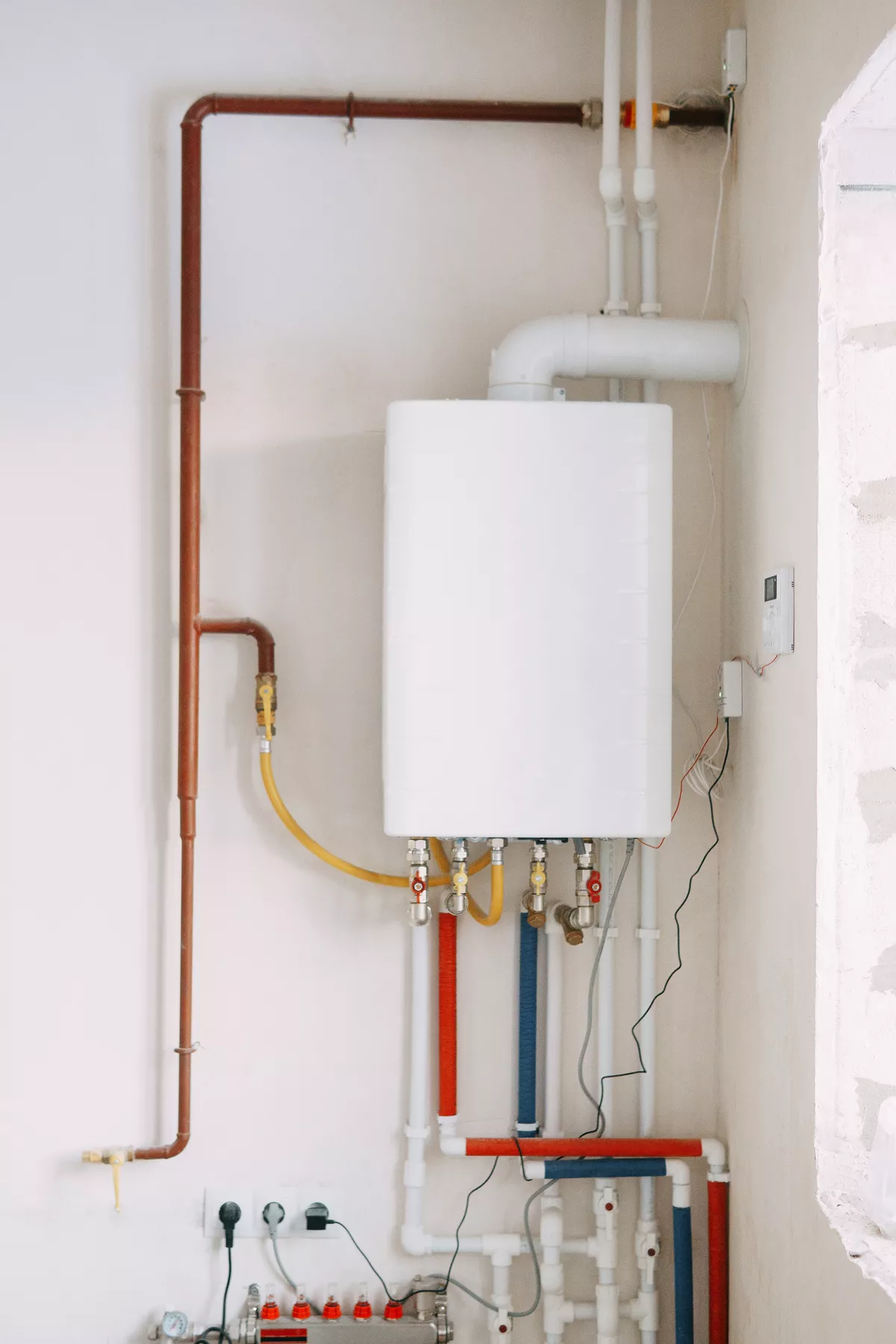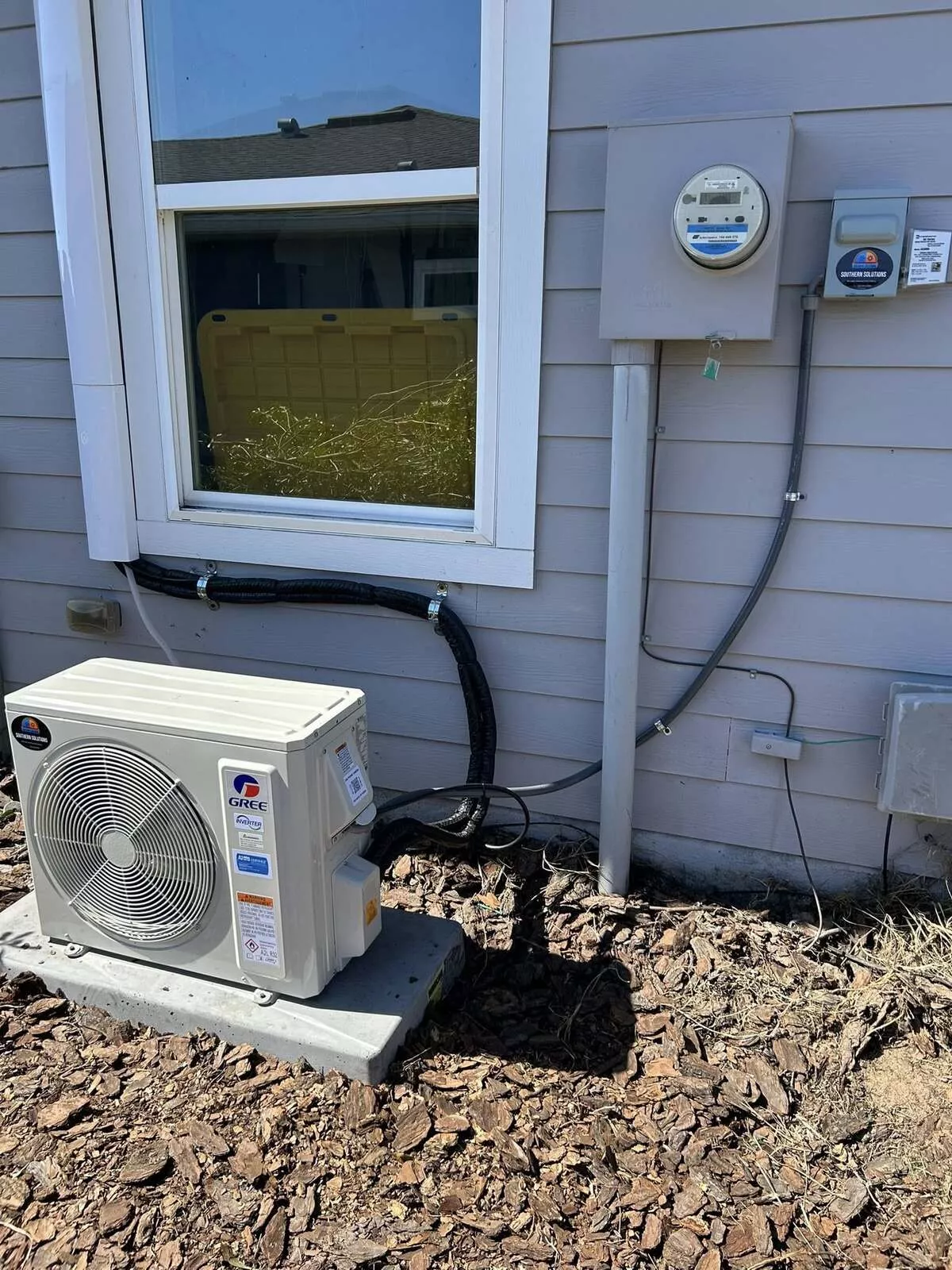
The old tank is failing, and the only place for a new one is the garage or an unfinished basement. A heat pump water heater sounds efficient, but it pulls heat out of the air around it, and in a Boulder winter that air can get cold. Will it still work? Will it chill the space, or the pipes next to it?
This post covers placement in a cold space, using what ENERGY STAR, the U.S. Department of Energy and Rheem’s installation guidelines say about temperature, air volume, ducting, condensate and noise. Electrical and plumbing work is for a licensed professional.
How does a heat pump water heater work?
A heat pump water heater moves heat instead of making it. EPA’s ENERGY STAR buying guide says it “works like a refrigerator in reverse,” capturing heat from the surrounding air and transferring it to the tank. Because it moves heat from the room air, the room it sits in matters as much as the tank.
ENERGY STAR notes these units are also called hybrid electric water heaters, because some models “can switch modes to operate like a standard electric model when needed.” That backup mode is the key to the cold-space question: when the surrounding air is too cold, a hybrid unit falls back on its electric elements.
Weighing whether a heat pump water heater is worth it
On efficiency, the federal numbers are strong. ENERGY STAR’s buying guide says a certified heat pump water heater “uses 70% less electricity to make the same hot water as a standard electric model.” Whether that pays off in a given house depends on where the tank goes, because a cold location cuts into those savings.
The same guide estimates the savings on a 50-gallon model at “$315 per year” and charts average annual energy cost at $436 for a standard electric storage tank against $122 for an ENERGY STAR heat pump model. Those are national 2021 figures against an electric tank, not a Boulder or gas comparison.
The caveat sits on ENERGY STAR’s product page. In “colder environments with lower incoming water temperature,” it says, the units “may need to go temporarily into a back-up standard electric water heating mode to meet household hot water use in colder months. This will increase energy use during these months.” In other words, the cold-season savings depend on the room temperature and on how cold the water coming into the house is.
What temperature range does a heat pump water heater need?
ENERGY STAR says these units “should be installed in interior spaces that remain between 40° to 90° F year-round.” The Department of Energy uses the same range. Rheem lists a wider operating range for one model, 37 to 145°F, but the federal guidance for good performance is a space that stays at 40°F or above all year.
The buying guide adds a nuance: “Many models can operate outside this range for short periods of time, but ideally the tank should be placed somewhere that remains above freezing.” That matters for a garage. A tank and water lines in a space that falls below freezing face the same freeze risk as any other plumbing there.
Rheem’s spec sheet for its 120V dedicated-circuit plug-in model includes a U.S. map split at an average January ambient air temperature of 37°F. It says: “For optimal operation, installation in gray US map zone is recommended. When installing outside of gray zone, consult your local plumbing contractor.” The number to check is the temperature of the actual garage or basement in January, not the outdoor forecast.
Heat pump water heaters in a cold garage
It can, if the garage stays inside the temperature range and has enough air. ENERGY STAR’s buying guide describes the units as “ideal for clammy basements and stuffy garages” because of the cool, dry air they give off. The federal condition is a space that holds 40°F or above year-round. An uninsulated garage that freezes in January fails it.
So the real question is how cold this particular garage gets. A thermometer that records the minimum temperature, left in the spot through a cold snap, answers it better than a guess.
The Department of Energy presentation states the cost of getting it wrong: “Heat pump water heaters will not operate efficiently in a cold space. They tend to cool the spaces they are in.” In a cold garage the backup does more of the work, and the exhaust air lowers the temperature further. Freeze protection for the tank and lines is a plumbing question for the installer to settle on site.
Is a basement a better spot?
A basement can be a strong location, especially one with a furnace. DOE’s guidance is to “install them in a space with excess heat, such as a furnace room,” and ENERGY STAR’s product page makes the same suggestion. A basement that holds the furnace and stays above 40°F all year fits the federal guidance more easily than an unheated garage.
There is a trade-off. DOE notes: “Heat extracted by the HPWH from a conditioned space in the heating season may require more heat from the existing space heating system.” In summer the effect reverses. ENERGY STAR says that “during hot humid times of the year, the water heater can help cool and dehumidify the space it is installed in.”
| Location | Fits the 40-90°F guidance? | Main trade-off |
|---|---|---|
| Unheated garage that freezes | No | Lower efficiency, more backup heating, freeze risk to tank and lines |
| Garage that stays 40°F+ year-round | Yes | Cools the garage further in winter |
| Basement furnace room | Yes, if it stays 40°F+ | Takes some winter heat the furnace already produced |
| Small closet | Only with louvers or ducting | Air volume, per manufacturer specs |
How the basement, the ducts and the furnace interact is the kind of whole-house question covered in the year-round Boulder home systems guide.
How much air space does a heat pump water heater need?
ENERGY STAR’s product page says to “provide 1,000 cubic feet of air space around the water heater,” and DOE uses the same figure. ENERGY STAR’s buying guide gives a range: “about 750 to 1000 cubic feet of air, which is about the size of a 10 ft x 10 ft room.” Rheem sets requirements by room volume for each model.
Rheem’s spec sheet for its 120V dedicated-circuit plug-in model sets out room sizes:
| Room size (Rheem, 120V dedicated-circuit model) | Requirement |
|---|---|
| Larger than 1,200 cubic feet (e.g. 12′ x 10′ x 10′) | “No additional ventilation needed” |
| 400 to 1,200 cubic feet (e.g. 5′ x 8′ x 10′ to 12′ x 10′ x 10′) | “Full louvered door OR two louvers top and bottom. 2.9 ft² minimum louver area” |
| Smaller than 400 cubic feet, such as a closet | Ducted with outlet duct; “Full louvered door. 3.25 ft² minimum louver area” |
The volume that counts is free air: “Additional objects occupying the space reduce total space volume.” Rheem also warns that “insufficient air circulation may result in an ambient air temperature drop more than 15° F (8° C) and inefficient operation.” These figures are for one Rheem model; ENERGY STAR’s advice for every brand is “Always follow manufacturer’s specifications.”
Can the cold exhaust air be ducted?
Yes. DOE says “cool exhaust air can be exhausted to the room or outdoors,” and ENERGY STAR’s buying guide says that “although not required, the cool air can be ducted directly outside or to adjacent rooms.” Ducting is one way to keep a cold garage or small room from getting colder, but it is installer work, not a homeowner step.
Rheem lists termination kits “to the outside or to the attic” for its plug-in model, with the note “Insulate ducting to reduce condensation.” Duct sizing, routing and wall penetrations follow the manual and local code, and belong to the installer.
Cold spaces, room cooling and upfront cost
The federal sources name four: lower efficiency in cold spaces, cooling of the room, higher upfront cost and a longer installation. ENERGY STAR says the units “generally don’t operate as efficiently in colder spaces, and can cool the spaces they are in.” They also need more room and produce condensate that has to drain.
The buying guide says they “typically cost more upfront” and “are generally a bit larger than conventional water heaters.” ENERGY STAR’s product page adds that “it may take longer to install than a standard water heater.” Each downside is a placement or planning question, so the location decision comes before the product decision.
Condensate, noise and electrical needs
A heat pump water heater pulls moisture out of the air, makes a low hum while the compressor runs, and needs the right electrical supply. ENERGY STAR’s buying guide covers all three, and each changes what the installation involves, so raise them when getting quotes.
Condensate. The buying guide says the units “produce pure, clean, non-corrosive condensate water which can be directed to an existing drain or condensate pump.” Rheem’s plug-in spec sheet lists “3/4″ condensate drain connections.” A garage or basement without a nearby floor drain may need a pump. The drain line also has to stay above freezing to keep working, which is one more reason the garage temperature matters.
Noise. ENERGY STAR says “a low soft humming sound is normal for a heat pump water heater-similar to a new dishwasher or refrigerator.” Rheem’s spec sheet lists a sound level of 55 dBA for its 120V plug-in model. Placement next to a bedroom wall is worth thinking about.
Electrical. Per the buying guide, “the most common type of heat pump water heater requires a dedicated 240 Volt outlet,” and “electric panel upgrades may be needed if replacing a gas water heater or if a 240V outlet is not available.” Rheem’s 120V model plugs into a dedicated circuit with a 15-amp minimum breaker, per its spec sheet. Which option fits a given panel is a question for a licensed electrician.
Replacing a gas water heater with a heat pump
Yes, with electrical work. Rheem’s spec sheet says its 120V plug-in model “easily replaces a standard gas water heater,” and ENERGY STAR’s buying guide notes that 240-volt models may need a panel upgrade when replacing gas. The gas line has to be capped by a qualified professional, and the electrical supply checked before the swap.
ENERGY STAR says heat pump units “do not require extra venting to remove exhaust gases.” That removes the flue, but adds the temperature range, air volume, drain and circuit. A spot that suited a gas tank does not automatically suit a heat pump model.
For a home also weighing a heat pump for space heating, the cold climate heat pump guide covers the heating side, and heat pump installation cost in Boulder covers what goes into a quote.
What a homeowner can check before the installer visits
The homeowner part of this job is observation, not installation. Four checks help an installer give an accurate answer: the unit’s air filter, clearances, the thermostat and the carbon monoxide alarm. Water lines, gas, wiring, ducting and the refrigerant circuit belong to a professional.
- Filter. ENERGY STAR’s buying guide says “most manufacturers have a filter alarm to indicate when the filter should be cleaned.” Follow the owner’s manual once installed.
- Clearances. Measure the free space around the planned spot. Rheem’s plug-in model lists minimum clearances without ducting of 0 inches rear, 3 inches sides and 9 inches top. Keep the area clear after installation.
- Thermostat. Note the house thermostat setting if it affects the space, and log the lowest temperature the space reaches during a cold week, to compare with the 40-90°F guidance.
- CO alarm. Keep a working carbon monoxide alarm while any gas furnace, range or attached garage remains. If it sounds, leave the building and call 911 from outside. Next steps are in what to do when a carbon monoxide alarm goes off.
So, where should a heat pump water heater go?
Per ENERGY STAR and DOE, in an interior space that stays between 40°F and 90°F all year, with about 1,000 cubic feet of free air, a drain for condensate and the right circuit. A basement furnace room fits that description best. A garage works only if it holds the temperature range through January.
Where the space falls short, the sources point to louvers, ducting or a different location. The deciding documents are a minimum-temperature reading of the space and the manual for the exact model.
For installation, Boulder HVAC Pros offers water heater installation in Boulder, serving Boulder and the surrounding area. Call (720) 764-0399.
Frequently asked questions
What are the downsides of a heat pump water heater?
Per ENERGY STAR and DOE: lower efficiency and more electric backup use in cold spaces, cooling of the room, a higher upfront cost, a larger tank, a longer install, a condensate drain and a low compressor hum.
Is a heat pump hot water system worth it?
ENERGY STAR’s buying guide says a certified model uses 70% less electricity than a standard electric tank and estimates $315 per year in savings on a 50-gallon model. Savings fall in cold spaces, where backup electric mode runs more.
Can a heat pump replace a water heater?
Yes, if the location stays between 40°F and 90°F and has enough air, a drain and the right circuit. Replacing gas may need electrical upgrades, per ENERGY STAR.
Can I install a heat pump water heater myself?
The installation involves water connections, an electrical circuit, a condensate drain and sometimes ducting or capping a gas line. Those are jobs for licensed plumbing and electrical professionals, following the manufacturer’s manual.
Can a heat pump water heater be installed in an unheated garage?
Only if the garage stays at 40°F or above year-round, per ENERGY STAR and DOE. A garage that freezes falls outside the guidance, and DOE says the units “will not operate efficiently in a cold space.”
Last verified: October 16, 2026.
Related reading and services: Heat Pump · HVAC services in Boulder, CO · Heat Pump Installation Cost in Boulder: What Drives the Number on a Quote