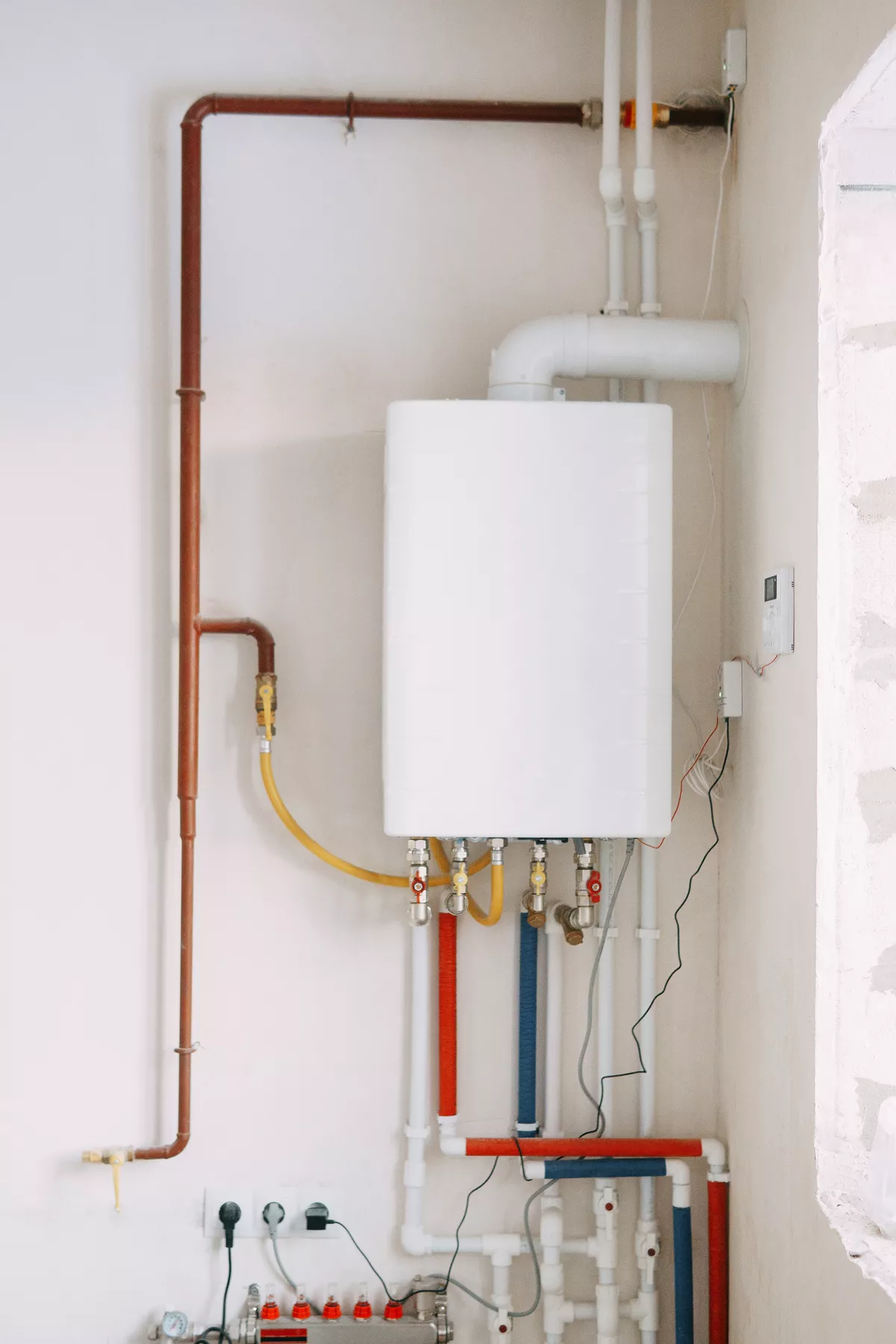
The furnace filter is the one piece of heating maintenance that belongs to the homeowner. The manufacturer’s manual and ENERGY STAR both hand it over, and both are clear about why it matters. Goodman’s installation manual for one of its furnace lines says: “Improper filter maintenance is the most common cause of inadequate heating or cooling performance.”
The two questions people ask about filters are which MERV rating to buy and how often to change it. The honest answers are shorter than the advice built around them. The rating is a trade between what the filter catches and how hard it makes the blower work, and the limit on how high you can go is set by your furnace, not by the filter aisle. The change interval is not a number of days. It is whatever your filter needs, found by checking it.
What a MERV rating is
The U.S. Environmental Protection Agency defines it plainly. “Minimum Efficiency Reporting Values, or MERVs, report an air filter’s ability to capture particles between 0.3 and 10 microns.” The rating comes from a test method developed by ASHRAE, the engineering society for heating and cooling, and “the higher the MERV rating, the better the filter is at trapping specific sizes of particles.”
EPA publishes the capture figures behind each rating. For the three ratings people compare most, its table reads:
- MERV 8: at least 20 percent of particles from 1.0 to 3.0 microns, and at least 70 percent from 3.0 to 10.0 microns. No minimum is set for the smallest band, 0.3 to 1.0 microns.
- MERV 11: at least 20 percent from 0.3 to 1.0 microns, 65 percent from 1.0 to 3.0, and 85 percent from 3.0 to 10.0.
- MERV 13: at least 50 percent from 0.3 to 1.0 microns, 85 percent from 1.0 to 3.0, and 90 percent from 3.0 to 10.0.
At the bottom of the scale, EPA’s table sets MERV 1 to 4 at less than 20 percent of the largest band, 3.0 to 10.0 microns, and nothing for anything smaller. At the top, a HEPA filter, which sits outside the MERV scale, is listed at 99.97 percent or better at 0.3 microns. EPA describes the rating’s purpose as “helpful in comparing the performance of different filters, particularly for furnace or central heating, ventilation, and air conditioning (HVAC) systems.”
The difference that matters is at the small end. MERV 8 carries no requirement for the finest band. MERV 13 must catch at least half of it. That band is what separates the ratings, and it is why the smoke guidance later in this guide, which is about fine particle pollution, points to MERV 13.
How high your furnace can go
This is the question the filter packaging cannot answer, and EPA says so directly. Its advice is to choose “a filter with at least a MERV 13 rating, or as high a rating as your system fan and filter slot can accommodate,” and it adds: “You may need to consult a professional HVAC technician to determine the highest efficiency filter that will work best for your system.”
That qualifier is the whole story. A filter that catches more also resists airflow more, and the furnace has limits on how much resistance it can work against. After finding the filter, the manufacturer’s limits sit in two places: the filter size and the static pressure.
Where the filter sits
Before sizing anything, find the filter. Goodman’s manual explains that “differing filter arrangements can be applied” depending on the installation, and that “filters can be installed in either the central return register or a side panel external filter rack (upflow only).” So the filter may be behind a grille in a wall or ceiling, or in a slot on the side of the furnace or in the return duct beside it. Some homes have both. Check for a second filter before assuming there is only one, and note the size printed on each frame.
The filter size
Goodman’s manual tells owners and installers to “adhere to the filter sizes given in the recommended Minimum Filter Size Table or Specification Sheet applicable to your model.” That table exists because filter area matters. A filter smaller than the model calls for pushes the same air through less material.
The static pressure
The manual also requires that a furnace run “with a duct system which has external static pressure within the allowable range, as specified on the furnace rating plate.” External static pressure is the resistance the whole air path puts up against the blower, and the filter is part of that path. A filter change that pushes the reading above the allowable range has gone too far for that furnace, and a filter change that leaves it inside the range is one the furnace can take.
That reading is not a guess. It is measured with a manometer on either side of the furnace and written on the manufacturer’s own start-up record sheet, alongside the temperature rise and the gas pressures. It is part of heating maintenance and tune-ups. Asking for the static pressure reading with the filter you intend to use is the direct way to settle whether it suits your furnace.
What too much resistance looks like
When airflow falls, the furnace runs hotter across its heat exchanger. The manual requires that “the air temperature rise must be within the range listed on the furnace nameplate,” and a restricted filter is one of the things that can push the rise out of range. The furnace’s limit switch exists to catch exactly that, which is covered in how a furnace’s safety switches work. A furnace that keeps shutting itself off early is covered in furnace short cycling, and vents blowing cool air in furnace blowing cold air. A clogged or overly restrictive filter is one of the first things to rule out in all three.
Thicker filters
The manual notes that “a media air filter or electronic air cleaner can be used as an alternate filter.” Whether a particular media cabinet suits your furnace is the same question as before: does the air path stay inside the allowable static pressure? The answer comes from the furnace’s documents and a reading, not from the depth of the filter.
How often to check, and when to change
This guide does not give a replacement interval in days. The sources frame filter care as a check first, with cleaning or replacement when the check calls for it, and what a filter catches depends on the filter, the house and the season.
ENERGY STAR’s maintenance checklist gives the homeowner one task in these words: “Inspect, clean, or change air filters once a month in your central air conditioner, furnace, and/or heat pump.” Its reason is direct: “A dirty filter can increase energy costs and damage your equipment, leading to early failure.” The manufacturer’s manual says filters “should be cleaned (permanent) or replaced (disposable) as required.” EPA’s own page adds: “All filters require periodic replacement to function properly. Follow the manufacturer’s recommendations on maintenance and replacement.”
Put together, the instruction is to check the filter, and to clean or change it when the check shows it needs it. That depends on what the filter is catching, which changes with the house and the season. The filter’s own packaging and the furnace manual are the documents to follow for that specific filter.
What “needs changing” looks like
A filter that needs changing is visibly different from a new one. Compare it against a spare of the same type:
- Colour. The side facing the return air has turned grey or dark across its surface, not just in patches.
- Coating. Dust or lint sits on the surface as a visible layer rather than inside the pleats.
- Light. Held up to a light, it passes noticeably less than a new filter does.
- Shape. It is bowed, torn, or pulled away from its frame, or it no longer seals in its slot. Air that goes around a filter is not filtered.
- Wet or damaged. Any filter that has got wet, or shows mould, should be replaced.
A reusable filter follows its maker’s cleaning instructions. A disposable one is replaced. Either way, note the size printed on the frame and fit the same size, matching the one the manual’s table calls for.
What smoke season changes
Smoke changes the filter question. Boulder County Public Health frames it as fine particle pollution, and EPA’s recommendation, quoted above, is at least MERV 13 or the highest rating the system can take.
Boulder County Public Health has given the same advice locally. In a July 31, 2024 release on wildfire smoke, it advised residents to reduce fine particles indoors using the HVAC system: “Run the fan continuously and close the outdoor air intake or use recirculate mode. Use your system’s highest Minimum Efficiency Reporting Value (MERV) filter if possible. A filter rated MERV 13 or higher is best to effectively reduce fine particle pollution in indoor air.” The county’s page marks that release as more than a year old, so check Boulder County Public Health for current guidance during any smoke event.
The same release set the furnace filter alongside other measures rather than on its own. It advised residents to “consider using a correctly sized portable air cleaner with a high-efficiency Particulate Air (HEPA) filter if possible”, to “avoid running swamp coolers or whole house fans”, which pull outdoor air in, and to avoid indoor sources such as “burning candles, smoking, vaping or using a stove or fireplace.” For current conditions, it pointed residents to airnow.gov.
Two points follow from the rest of this guide. Both agencies qualify the rating by what the system can take: EPA’s “as high a rating as your system fan and filter slot can accommodate”, and the county’s “your system’s highest” filter “if possible”. And a filter working through a smoke event is one to check during and after it, rather than rely on a calendar. Getting the answer before smoke season, with a static pressure reading, is easier than finding it mid-event.
What a homeowner can do, and what stays with a technician
The filter is yours. Checking it, reading the size printed on the frame, and fitting the same size are the owner’s tasks in both the manual and ENERGY STAR’s checklist. Keep the space around the furnace and the return grilles clear.
Measuring static pressure and temperature rise, and anything inside the furnace cabinet, is technician work. If changing to a higher-rated filter is on the table, that is the point to ask for the static pressure reading, as part of heating maintenance and tune-ups. How filter care fits into the rest of heating a home here is in the guide to winter heating in Boulder.
Frequently asked questions
What MERV rating is best for a home furnace? EPA recommends at least MERV 13 “or as high a rating as your system fan and filter slot can accommodate.” The limit is your furnace’s: the filter size in the manufacturer’s table and the allowable static pressure on its rating plate. A static pressure reading with the filter in place settles it.
Is MERV 13 too high for a furnace? It depends on the furnace. EPA itself qualifies its MERV 13 advice by what “your system fan and filter slot can accommodate.” If the static pressure with a MERV 13 filter stays within the allowable range on the rating plate, the furnace can take it. If it does not, it is too restrictive for that furnace.
Which is better, MERV 8, 11 or 13? By EPA’s table, each catches more of the fine particles than the last: MERV 8 has no requirement for particles from 0.3 to 1.0 microns, MERV 11 must catch at least 20 percent of them, and MERV 13 at least 50 percent. Better filtration comes with more airflow resistance, so the right one is the highest your furnace can take without leaving its allowable static pressure.
Will a MERV 13 filter damage my AC or furnace? The sources frame the question as airflow, not the filter itself. A filter too restrictive for the blower lowers airflow, which can push the furnace’s temperature rise out of range and trip its limit switch. The manual’s allowable static pressure is the test, and a technician’s reading answers it.
How often should I change my furnace filter? Check it, and change it when it needs changing. ENERGY STAR’s checklist says to “inspect, clean, or change air filters once a month,” and the manufacturer says filters should be cleaned or replaced “as required.” What a filter that needs changing looks like is described above.
How can I tell if my furnace filter needs changing? Compare it with a new one of the same type. Look for a grey or dark surface across the whole face, a visible layer of dust or lint, less light passing through, or a filter that is bowed, torn, wet or no longer sealing in its slot.
What should I do with my filter during wildfire smoke? Boulder County Public Health’s July 31, 2024 guidance was to run the fan continuously with the outdoor air intake closed or on recirculate, and to use the system’s highest MERV filter if possible, with MERV 13 or higher best. Check current county guidance during any event, and check the filter during and after it.
Sources
- U.S. EPA, What is a MERV rating? (definition, ASHRAE test method, capture table, MERV 13 recommendation and qualifier, replacement guidance) – https://www.epa.gov/indoor-air-quality-iaq/what-merv-rating
- Boulder County Public Health, Health Guidance for Poor Air Quality Due to Wildfires on the Front Range (news release, July 31, 2024; marked by the county as more than one year old) – https://bouldercounty.gov/news/health-guidance-for-poor-air-quality-due-to-wildfires-on-the-front-range/
- ENERGY STAR, Maintenance Checklist – https://www.energystar.gov/saveathome/heating-cooling/maintenance-checklist
- Goodman, Installation Instructions for *M9S80 & *C9S80 gas furnaces (filter maintenance, minimum filter size, alternate media filter, static pressure, temperature rise) – https://documents.alpinehomeair.com/product/goodmangm9s8gc9s8installationmanual.pdf