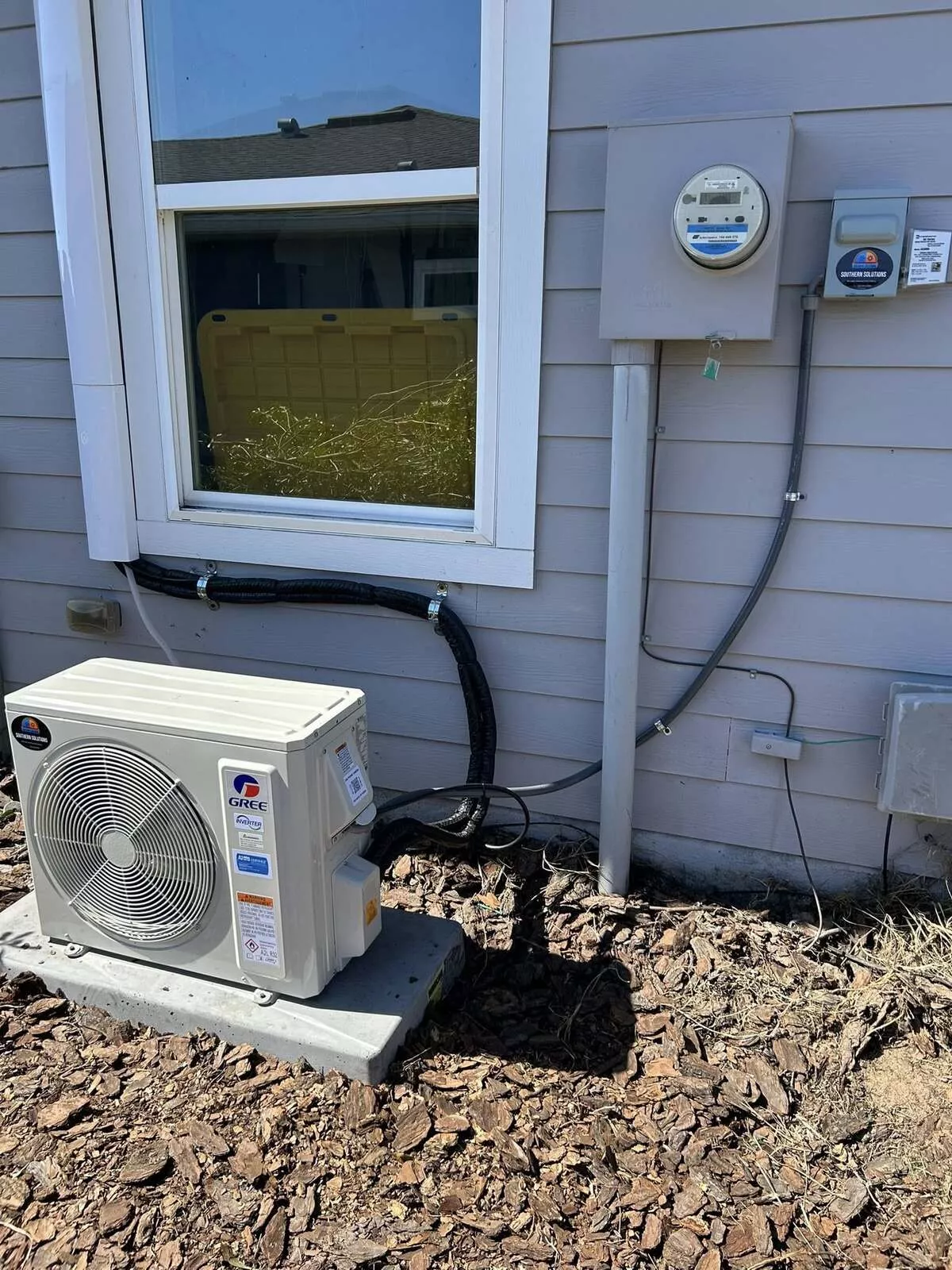
Every heat pump maker now uses the words cold climate somewhere in its brochure. The phrase on its own tells you very little. Two public yardsticks give it a definite meaning: the ENERGY STAR cold climate designation, and the cold-climate air source heat pump (ccASHP) list kept by Northeast Energy Efficiency Partnerships (NEEP). This post explains what each one tests, how to read a NEEP listing, and what to ask an installer before you sign.
It is about choosing equipment. If your heat pump is already installed and you want to know why it runs constantly or steams in January, the guide to heat pumps in Boulder cold covers that, and the post on auxiliary and emergency heat explains why backup heat raises the bill.
Why the standard ratings say little about cold weather
Every heat pump sold carries an HSPF2 rating for heating and a SEER2 rating for cooling. The ENERGY STAR key product criteria define HSPF2 as the total heating delivered over a season divided by the electricity used. It is a seasonal average for a reference climate, not a measure of what the unit does on the coldest night.
NEEP set out the problem directly on its ccASHP specification page. It says: “The current performance metric (HSPF) does not include low temperature testing points below 17°F, assumes the use of electric resistance elements, and tests in steady-state operation (as opposed to allowing modulation).” NEEP adds that manufacturers’ own cold-temperature data “is not standardized or consistent.”
Both cold-climate yardsticks fill that gap with a test at low temperature.
What does the ENERGY STAR cold climate label require?
ENERGY STAR certifies heat pumps at two levels. The base level, per its key product criteria, is at least 7.8 HSPF2 and 15.2 SEER2 for split systems. The cold climate level asks for more heating efficiency: at least 8.5 HSPF2 for non-ducted split systems and at least 8.1 HSPF2 for ducted split systems, each with at least 15.2 SEER2.
Then comes the low-temperature test. The criteria say: “To earn the Cold Climate designation, heat pumps must demonstrate low ambient performance by meeting the following.” There are three parts:
- Efficiency at 5°F. A coefficient of performance (COP) of at least 1.75 at 5°F. ENERGY STAR defines COP as “the ratio of the average rate of space heating delivered to the average rate of electrical energy consumed by the heat pump.” A COP of 1.75 means the unit delivers 1.75 units of heat for each unit of electricity.
- Capacity at 5°F. Heating capacity at 5°F of at least 70% of the capacity at 47°F. This is the number that tells you how much of its mild-weather output the unit keeps when it gets cold.
- A controls check. A controls verification procedure must confirm the 5°F results “are achieved by the native controls” of the unit as it would run in a home, not only in a lab setting.
ENERGY STAR’s air-source heat pump page sums it up: “The ENERGY STAR certification requires third-party verified performance for low temperatures, testing ASHPs down to 5°F.” It also says the 5°F test is not the floor: “Your cold climate ASHP will continue working at temperatures below 5°F, but pairing it with a back-up energy source will heat your home the most efficiently when temperatures are even lower.”
What is the NEEP cold-climate list?
NEEP is a regional energy efficiency organization based in Boston. Its specification page says the specification “was designed to identify air source heat pumps that are best suited to heat efficiently in cold climates (IECC climate zone 4 and higher).” It is intended as a minimum requirement for utility and efficiency programs, and also for “engineers, contractors, and other practitioners who need assurance that the equipment they select will have the required heating capacity at design temperature without unnecessary oversizing.”
The current rules are in the ccASHP Specification Version 4.0, effective January 1, 2023. For a central heat pump, the main requirements are:
- A variable-capacity compressor. The specification says: “Compressor must be variable capacity (three or more distinct operating speeds, or continuously variable).” A single-speed unit cannot qualify.
- Heating and cooling efficiency. For non-ducted systems, HSPF2 of at least 8.5 and SEER2 of at least 15. For ducted systems, HSPF2 of at least 7.7 and SEER2 of at least 14.3.
- Efficiency at 5°F. A COP of at least 1.75 at 5°F at maximum capacity operation.
- AHRI certification. Units must be certified to AHRI Standard 210/240, the industry rating standard for heat pumps.
Note the ducted HSPF2 floor differs between the two: 7.7 for NEEP and 8.1 for the ENERGY STAR cold climate level. A product can be on the NEEP list without holding the ENERGY STAR cold climate label, and the NEEP reporting template records both as separate yes or no fields.
The list itself is at ashp.neep.org. NEEP says listing makes “standardized cold-climate performance data available to contractors, designers, consumers, utilities, and program administrators” and helps users “compare and select systems.” One caution from the list’s home page: after NEEP moved to a new data process with AHRI, it warns that “some eligible products have not yet been properly reported to AHRI.” A model missing from the list today is not proof it fails the specification.
NEEP also says the list makes it easier for programs “to identify products for potential incentive eligibility.” For what is currently on offer in Boulder County, see the post on Boulder heating rebates, which tracks what has ended and what remains.
Reading a NEEP listing: the numbers that matter
The value of the NEEP list is the table behind each model. The Version 4.0 specification requires manufacturers to report heating capacity, power input and COP at 47°F, 17°F and 5°F, at minimum and maximum output, plus a Lowest Cataloged Temperature. NEEP defines that as “the lowest outdoor dry bulb temperature at which the manufacturer offers published performance data in technical manuals or product documentation.”
Read a listing in this order:
| What to look at | Why it matters |
|---|---|
| Maximum capacity at 5°F (Btu/h) | The heat the unit can deliver continuously on a cold night |
| Maximum capacity at 47°F | Divide the 5°F figure by this to see how much output is kept |
| COP at 5°F | Efficiency when it is cold; NEEP’s floor is 1.75 |
| Minimum capacity at 47°F | How far the unit can turn down in mild weather |
| Lowest Cataloged Temperature | The coldest point with published data |
| Ducting configuration and AHRI number | Confirms the exact indoor and outdoor pairing you were quoted |
The maximum figures matter because NEEP asks for capacity the unit “can deliver continuously” at each condition.
The listing is tied to a matched system, not to an outdoor unit alone. BASC’s ductless mini-split guide says AHRI “assigns a certification number and efficiency ratings to specific combinations of equipment.” The same outdoor unit with a different indoor coil or air handler can carry different numbers. Check that the AHRI reference on your quote matches the listing you looked up.
NEEP’s own specification warns against treating the list as a shortcut: “simply meeting the performance requirements does not necessarily mean a product is appropriate for all applications.” It says consumers, contractors and designers “should review building loads, equipment capacities at design temperatures, and other important factors before selecting equipment.”
Ducted, ductless or mixed configurations
The NEEP specification covers non-ducted wall, floor and ceiling units, multizone systems of all ducted, all non-ducted or a mix, and singlezone ducted systems, both compact and centrally ducted. So a cold-climate rating is available whether you are replacing a furnace that feeds ducts or adding heads to a house with none.
BASC says there are now many ductless models that heat reliably at very cold temperatures, and that “some models can operate at an outdoor temperature of -15°F for heating, eliminating the need for backup heat sources in many locations.” If you are weighing ducts against no ducts, the comparison of mini-split vs central air covers that choice. If the question is whether to replace an old air conditioner with a heat pump at all, see heat pump vs air conditioner.
How should a cold-climate heat pump be sized?
Sizing decides whether the cold-climate rating does its job. ENERGY STAR says: “Your contractor should verify the proper size system for your home using a tool called” Manual J, a calculation of the heating and cooling the home needs. The post on Manual J load calculations explains what that calculation includes.
For heating in a cold climate, BASC goes further. It says “alternative sizing methods should be used if the heat pump is to be used primarily for heating in a cool or cold climate,” and names NEEP’s list, Natural Resources Canada’s sizing guide and a DOE training module. It also says to use the manufacturer’s “expanded performance table to obtain performance data at design conditions, rather than using the performance data on the AHRI certificate.”
That is professional work; the homeowner’s part is to ask for the numbers.
Backup heat is part of the same decision. ENERGY STAR says “a good contractor will work with you to determine the size and potential integration with a back-up heating system that will work best for your home.” That backup may be electric strips or a gas furnace kept in place; the guide to dual-fuel heat pumps covers the second option, and the post on aux heat lockout covers when backup should switch on.
Siting the outdoor unit for snow and ice
A unit’s rated cold-weather capacity assumes air can reach the coil. BASC’s cold-climate recommendations say to “install outdoor units well above snow height” using stands or wall mounts, and not to install them “where water or melting snow or ice will fall on the unit.” It describes a unit placed beneath a deck where melting snow dripped and froze on it, which “dramatically reduced the heat pump’s capacity and efficiency.”
Mounting height, stands, condensate routing and wall attachment are installer decisions; ask where the unit will go and why.
What should you ask the installer before signing?
A written quote for a cold-climate heat pump should let you check the claims yourself. Ask for:
- The AHRI reference number for the exact indoor and outdoor combination.
- The NEEP listing for that combination, or the manufacturer’s expanded performance data if it is not yet listed.
- Maximum heating capacity at 5°F, and the ratio to capacity at 47°F.
- COP at 5°F.
- The load calculation, with the design heating load stated in Btu/h, so you can compare it with the 5°F capacity.
- The backup plan: what provides heat below the heat pump’s capacity, and at what temperature it engages.
- Whether the model carries the ENERGY STAR cold climate designation, which some programs ask for.
- The outdoor unit location, mounting height and how meltwater will drain.
For cost, quotes vary with the house; the guide to heat pump installation quotes explains what drives the number. For checking the contractor rather than the equipment, how to choose a heating contractor lists what you can verify. The pillar guide to a home energy audit in Boulder explains how insulation and air sealing can shrink the heating load before you size anything.
What a homeowner looks after
Once a cold-climate heat pump is in, the homeowner’s part is four things.
- Filter. ENERGY STAR says “heat pump filters should be cleaned when visibly dirty or when indicated by the filter light.” BASC cites a typical manufacturer recommendation to clean ductless mesh filters every two weeks.
- Clearances. Keep snow, plants and stored items away from the outdoor unit so air can reach the coil, and keep furniture and curtains clear of indoor heads and return grilles. Clearing snow means a broom or by hand around the unit, never tools on the coil or fins.
- Thermostat. ENERGY STAR’s tip is to “avoid Auto mode” and set the heat pump to heat or cool so it does not switch modes on unseasonable days. For choosing a compatible control, see the smart thermostat guide; for settings, see winter thermostat settings.
- CO alarm. An all-electric heat pump burns no fuel, but a house with a gas furnace kept as backup, a gas water heater or a fireplace still needs a working carbon monoxide alarm. If it sounds, leave the building and call 911 from outside.
Refrigerant, wiring, the defrost controls, condensate drains and anything past the filter access are for a heating and cooling professional.
Boulder HVAC Pros offers heat pump installation across Boulder, Lafayette, Louisville, Superior, Erie, Broomfield, Longmont and the rest of our Boulder County service area, plus heat pump service for existing systems. Call (720) 764-0399.
Frequently asked questions
What is the difference between a heat pump and a cold climate heat pump?
A cold climate model has to prove performance at 5°F. ENERGY STAR requires a COP of at least 1.75 and at least 70% of 47°F capacity at 5°F, verified with the unit’s own controls. NEEP also requires a variable-capacity compressor.
Which heat pump is best for cold climates?
No fetched source ranks brands. NEEP’s list lets you compare models by capacity and COP at 5°F, and NEEP warns that meeting its specification does not make a product right for every home. The load calculation decides.
What is a major disadvantage of a heat pump for cold climates?
Output falls as it gets colder. ENERGY STAR says a cold climate unit keeps working below 5°F, but pairing it with a back-up energy source heats the home most efficiently when temperatures are even lower.
Is a cold climate heat pump worth it?
ENERGY STAR says that although these products can cost more up front, “the cost difference will be paid back over time through lower energy bills.” Whether that holds for one house depends on its load and the backup heat.
Does a cold climate heat pump need backup heat?
BASC says some models can heat at -15°F, removing the need for backup in many locations. ENERGY STAR says a good contractor will work out the size and any integration with a back-up heating system for your home.
Last verified: October 16, 2026.
Related reading and services: Heat Pump · HVAC services in Boulder, CO · Heat Pump Installation Cost in Boulder: What Drives the Number on a Quote